
The Resurgence of Timber Towers & CRE
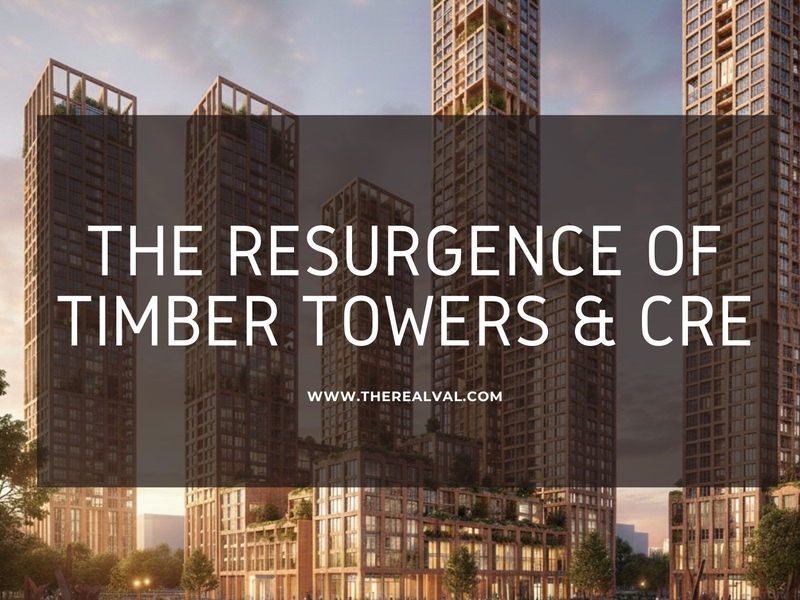
As the world economies move toward decarbonization and sustainability; timber towers are gaining traction across commercial real estate. Timber towers, which were once limited to small-scale or niche projects; are now rising across American cities, challenging the long-standing dominance of steel and concrete.
Engineered wood buildings don’t just produce less pollution when they’re built; they actually lock in carbon for decades. Traditional steel and concrete buildings, on the other hand, release a big chunk of their total emissions before anyone even moves in, which is why the carbon footprint of construction is becoming a serious concern for developers and investors.
Thus, what was once seen as an architectural experiment is now gaining serious interest from developers, investors, tenants, and policymakers. This makes timber no longer just a design choice, but also a strategic factor in modern CRE development.
What Are Timber Towers and Mass Timber?
Timber towers are mid-rise to high-rise buildings that use mass timber as a primary structural material. Mass timber includes engineered wood products such as cross-laminated timber and glue-laminated timber. These materials are designed to offer strength and durability comparable to steel and concrete.
Because mass timber components are manufactured off-site and assembled quickly, projects often require lighter foundations and shorter construction timelines. This has enabled the rise of taller timber and hybrid buildings (also called “plyscrapers”) that combine wood with steel or concrete while meeting strict safety and performance standards.
Importance of Timber Towers in Commercial Real Estate
- ESG and Sustainability Are Now Core CRE Metrics: Sustainability has become a central factor in CRE underwriting, leasing, and investment decisions. Mass timber plays a strong role here because wood stores carbon and has significantly lower embodied emissions than traditional building materials. Timber projects can reduce a building’s overall carbon footprint while supporting ESG-linked financing and corporate sustainability targets. For investors and developers focused on long-term value, and regulatory and sustainability alignment, this environmental advantage is increasingly hard to ignore.
- Strong Tenant Appeal and Better Experience: Timber buildings also offer a clear advantage in tenant experience. Exposed wood interiors, natural finishes, and warm aesthetics support biophilic design principles that are popular with office, retail, and mixed-use tenants. Creative firms, tech companies, and sustainability-focused occupiers often prefer timber buildings for their wellness benefits and distinct character. In competitive office markets, this differentiation can help newer, timber assets outperform older, conventional stock.
Notable Timber Projects
- Ascent MKE, Milwaukee, Wisconsin: A 25-story mass timber hybrid high-rise that is among the tallest in the world and showcases timber’s high-rise potential. It is crafted from sustainable wood for a living experience that feels warmer, and more natural.
- The Edison, Milwaukee, Wisconsin: An approved mass timber residential tower, the Edison is poised to become the world’s tallest timber building when the residential project tops out at 375 feet. The construction, however, has recently faced pauses.
- T3 Buildings: T3 stands for ‘Timber, Technology, Transit’. They include mid-rise timber office projects (like Minneapolis’ T3) that developed modern mass timber office use and also retail and mixed-use adaptations.
Investment Implications for CRE Stakeholders
- Faster Construction and Potential Cost Benefits: Mass timber buildings often complete faster than traditional structures, reducing on-site labour and shortening development timelines. Faster delivery can lead to earlier leasing, quicker cash flows, and lower interest carry; all of which are an important advantage in today’s high-rate environment.
- Valuation, Leasing, and Premium Potential: Timber buildings with strong sustainability and wellness credentials may command rental premiums, particularly in office and mixed-use segments. Their differentiation and ESG alignment can also support long-term tenant retention and yield stability.
- Risk, Insurance, and Underwriting Considerations: While modern mass timber meets strict fire and safety standards, lenders and insurers may still apply specialized underwriting criteria. Developers and investors need to proactively address these concerns through design, certification, and education of capital partners.
Challenges and the Future Outlook
Despite their growing momentum, timber towers are not without challenges. Initial costs can be higher, and adoption varies by jurisdiction depending on local codes, insurance practices, and market familiarity.
However, mass timber adoption is growing rapidly as supply chains improve and digital design, prefabrication, and construction technologies reduce waste and inefficiencies. As these systems mature, timber’s cost and execution risks are expected to decline.
Important Stats to Note-
- Construction using mass timber began in 2015 in the U.S., and has grown about 20% annually since then, and today there are over 2,500 mass timber projects built or in progress in the U.S.
- An Example: The new Under Armour building in Baltimore saved over 69% on embodied carbon, and it has achieved this by replacing steel and concrete with mass timber.
- Mass timber is usually costlier, but cost savings in construction and over the building’s life cycle can level that playing field.
- According to the 2024 International Mass Timber Report, production in Canada and the U.S., from 158,000 cubic meters in 2019 to 393,000 in 2023, and a climb in mass timber buildings constructed annually from 151 to 279 over the same period.
(Source: Trellis)
The resurgence of timber towers represents more than a passing trend. It reflects a deeper transformation in commercial real estate; driven by sustainability goals, tenant preferences, evolving regulations, and construction innovation.
For CRE developers, investors, and advisors, understanding mass timber is becoming a competitive necessity. Timber towers sit at the intersection of ESG performance, operational efficiency, and market differentiation.
If you are looking to leverage this rising momentum, and jump the bandwagon early; write to us at info@therealval.com, and let us underwrite your next sustainable project together!

Contact